Product Commercialization Consultant: The Process Behind Successfully Launching Products Into Competitive Markets
Product Commercialization Consultant: How Founders Bring Product Ideas to Market
A great product idea is exciting.
You can picture the brand, the packaging, the customers, the website, the first launch, and the moment your product finally reaches the market.
But bringing a product to market is not just about having the idea.
It is about knowing how to commercialize it.
That is where a product commercialization consultant becomes valuable.
Founders usually start asking:
What does a product commercialization consultant do?
How is commercialization different from product development?
Do I need a product development consultant, commercialization consultant, manufacturer, or launch agency?
How much does product commercialization consulting cost?
What is the typical timeline for bringing a product to market?
How do I choose the right commercialization strategy partner?
How do I know if my product is ready for launch?
What should happen before manufacturing?
How do I build a go-to-market plan?
How do I protect ownership, documentation, and product direction?
How do I avoid building a product that sits as inventory?
These are important questions.
Because a product does not become a business just because it exists.
A product becomes a business when it has a clear customer, clear positioning, clear launch pathway, responsible claims strategy, and a commercialization plan that supports long-term growth.
That is exactly why BiotechNmed Launch Lab exists.
BiotechNmed Launch Lab helps physicians, med spa owners, wellness entrepreneurs, skincare founders, supplement founders, beauty innovators, longevity founders, and product creators move from product idea to science-informed, market-ready product strategy with formulation direction, pilot planning, commercialization support, claims guardrails, documentation, and ownership in mind.
The goal is not just to help you launch a product.
The goal is to help you build a product you can actually own and confidently bring to market.
What Is a Product Commercialization Consultant?
A product commercialization consultant helps founders and businesses move a product from idea, prototype, or early development into a market-ready launch strategy.
Product commercialization is the bridge between product creation and product sales.
A product commercialization consultant may help with:
Market validation
Product positioning
Competitive research
Product-market fit
Pricing strategy
Go-to-market planning
Launch roadmap creation
Sales channel strategy
Packaging direction
Claims guardrails
Customer education strategy
Manufacturer readiness
Pilot launch planning
Market entry strategy
Scale-up planning
Product ownership strategy
In simple terms, a product commercialization consultant helps answer:
Who is this product for?
Why will the market care?
How should the product be positioned?
Where should the product be sold?
What does the launch pathway look like?
What must be clarified before production?
What claims need guardrails?
What documentation should the founder own?
How does this product become a business asset?
For skincare, supplement, wellness, beauty, longevity, and health-focused founders, commercialization is especially important because the product must be developed with the market, category, customer, claims language, manufacturing pathway, and ownership model in mind.
This is where BiotechNmed Launch Lab becomes the solution.
BiotechNmed Launch Lab does not only help founders think about the product.
It helps founders think about the pathway from idea to market-ready product asset.
Product Development vs. Product Commercialization
Many founders confuse product development and product commercialization.
They are connected, but they are not the same.
Product development focuses on creating the product.
Product commercialization focuses on bringing the product to market.
Product development may include:
Product concept
Formula direction
Ingredient research
Prototype planning
Packaging compatibility
Testing considerations
Pilot production planning
Product documentation
Manufacturer readiness
Product commercialization may include:
Market entry strategy
Product positioning
Pricing strategy
Go-to-market planning
Launch messaging
Sales channel planning
Customer education
Claims guardrails
Pilot launch feedback
Scale-up strategy
Long-term product roadmap
A product can be developed but not commercialized well.
That is where many founders lose time and money.
They create the product first, then try to figure out how to sell it later.
BiotechNmed Launch Lab helps founders avoid that mistake by connecting development and commercialization from the beginning.
The product should not be created in isolation.
It should be built with the market in mind.
Why Product Commercialization Feels Overwhelming
Most founders do not get stuck because the idea is weak.
They get stuck because they do not know how to move from idea to market.
They may already have:
A product idea
A product category
A target customer
A clinical, wellness, beauty, or founder background
A personal brand or audience
A med spa, clinic, or wellness practice
A desire to launch something proprietary
A vision for a product line
But they may not know:
If the product has real market demand
How to position the product
What makes the product different
What claims can be used responsibly
What price point makes sense
Which manufacturer conversations should happen first
What packaging direction supports the product
What documentation should exist
What should be tested before scale-up
How to avoid generic private label
How to build a product they actually own
That is why product commercialization consulting matters.
It gives founders a pathway before they make expensive decisions.
BiotechNmed Launch Lab helps founders move from scattered ideas to a structured commercialization roadmap.
That roadmap is what turns a product idea into a market-ready business asset.
The Biggest Mistake Founders Make: Treating Commercialization as the Last Step
Many founders think commercialization starts after the product is already made.
That is usually too late.
Commercialization should influence the product from the beginning.
Before investing heavily in formulation, packaging, inventory, or manufacturing, founders should understand:
Who the product is for
What market gap it addresses
What product format makes sense
What claims need guardrails
What price point is realistic
What launch pathway is appropriate
What sales channel fits the product
What customer education is needed
What documentation should be owned
What makes the product different from private label
When commercialization is treated as an afterthought, founders may end up with:
A product that is hard to explain
Packaging that does not fit the market
Claims language that needs revision
Pricing that does not support margins
A manufacturer relationship that creates dependency
Inventory without a clear launch plan
A product that looks finished but is not market-ready
This is why BiotechNmed Launch Lab starts with strategy.
The product pathway should be built before the product is scaled.
What Does a Product Commercialization Consultant Do?
A strong product commercialization consultant helps founders connect the product, the market, and the launch strategy.
For BiotechNmed Launch Lab clients, commercialization is not treated as a separate afterthought.
It is built into the full product pathway.
1. Product Opportunity Assessment
Before a founder invests in development, they need to know whether the product opportunity makes sense.
A product opportunity assessment helps answer:
What product idea are we evaluating?
Who is the target customer?
What category does the product belong in?
What problem, routine, or wellness goal does the product support?
What alternatives already exist?
What makes this product different?
Is the market already looking for something like this?
Does the founder have a realistic pathway to launch?
Can this become a product asset?
This step helps founders avoid building based only on excitement.
BiotechNmed Launch Lab helps founders evaluate the opportunity before production decisions become expensive.
2. Market Research and Competitive Intelligence
Product commercialization requires market awareness.
A founder needs to understand what customers already buy, what competitors offer, and where there is room to differentiate.
Market research may include:
Competitor product review
Category analysis
Pricing research
Customer behavior review
Ingredient trend research
Search behavior analysis
Sales channel review
Product format comparison
Positioning gap analysis
Customer education needs
For skincare founders, this may include reviewing professional skincare lines, direct-to-consumer brands, post-service skincare products, ingredient positioning, packaging styles, and customer routines.
For supplement founders, this may include reviewing delivery formats, ingredient positioning, subscription models, practitioner-based channels, and educational content.
For med spa owners and physicians, this may include reviewing what clients or patients already ask about, what products they currently buy elsewhere, and how a proprietary line could support the brand experience.
BiotechNmed Launch Lab helps founders look at the market before building the product.
Because a product should not be created just to exist.
It should be created to fit a real market opportunity.
3. Product Positioning
Product positioning defines how the product should be understood by the market.
This is one of the most important parts of commercialization.
Strong positioning helps clarify:
Who the product is for
What category it belongs in
What makes it different
Why customers should care
How the product should be described
What claims need guardrails
What emotional and practical value the product offers
How it fits into the founder’s brand
For BiotechNmed Launch Lab, positioning is especially important because many clients are experts, practitioners, med spa owners, or founders with credibility.
Their products should not feel generic.
They should feel aligned with their expertise, audience, and long-term brand.
That is the difference between selling a product and building a product asset.
4. Commercialization Strategy
A product commercialization strategy is the roadmap for bringing the product to market.
It helps answer:
What is the launch goal?
Who is the first target customer?
What is the product promise?
What claims language should be avoided?
What sales channel makes sense?
What content should support the launch?
What product education is needed?
What packaging direction supports the positioning?
What pricing model is realistic?
What pilot launch approach should be used?
What feedback should be collected?
What happens after the first launch?
For founders in skincare, supplements, wellness, beauty, and longevity, commercialization strategy should happen before the founder commits to large-scale production.
BiotechNmed Launch Lab helps founders build this roadmap so they are not launching blindly.
5. Go-To-Market Planning
A go-to-market plan explains how the product will reach customers.
For a skincare, supplement, wellness, beauty, or longevity product, the go-to-market plan may include:
Target audience
Sales channel
Launch offer
Product education
Founder story
Brand messaging
Email campaign strategy
Website or landing page direction
In-clinic sales strategy
Ecommerce strategy
Social content direction
Pilot customer feedback plan
Post-launch optimization
Different founders need different go-to-market plans.
A physician may launch through an existing professional audience.
A med spa owner may launch through existing clients and in-clinic education.
A skincare founder may launch through ecommerce, content, sampling, and routine education.
A supplement founder may launch through education, subscriptions, bundles, practitioner networks, or direct-to-consumer sales.
BiotechNmed Launch Lab helps founders choose a go-to-market pathway that fits the product, the audience, and the business model.
6. Claims and Messaging Guardrails
Product messaging matters.
This is especially true in skincare, supplements, wellness, beauty, longevity, and health-adjacent product categories.
Marketing claims should be clear, responsible, and properly supported.
For cosmetic products, FDA explains that cosmetics are generally intended for uses such as cleansing, beautifying, promoting attractiveness, or altering appearance, while products positioned for therapeutic uses may fall into a different regulatory category.
For dietary supplements, FDA explains that supplements are generally not approved by FDA before marketing and that they cannot be marketed to treat, prevent, or cure diseases.
FTC guidance also emphasizes that health-related advertising claims should be truthful, not misleading, and supported by appropriate evidence.
A product commercialization consultant should help founders think through:
What claims are appropriate
What claims need review
What language may create risk
How to align messaging with the product category
How to avoid overpromising
How to support product education responsibly
When to involve legal or regulatory professionals
BiotechNmed Launch Lab builds claims guardrails into the commercialization pathway.
Because the way a product is described can affect how it is understood.
7. Pricing Strategy
A product can be exciting and still fail commercially if the pricing does not work.
Pricing strategy should consider:
Cost of goods
Packaging costs
Manufacturing costs
Minimum order quantities
Channel margins
Shipping and fulfillment
Marketing costs
Founder profit goals
Customer willingness to pay
Competitive price range
Premium positioning
Future scale-up plans
For skincare, supplement, wellness, and beauty products, pricing should not be guessed.
It should be connected to the product strategy.
BiotechNmed Launch Lab helps founders think through commercialization before they lock themselves into a product that cannot support the business model.
8. Pilot Launch Planning
A pilot launch helps founders test the product before scaling.
Instead of launching with a large inventory commitment, a pilot approach can help founders gather early feedback and improve the path forward.
A pilot launch may help evaluate:
Product experience
Customer response
Packaging performance
Messaging clarity
Price point
Routine fit
Sales channel performance
Education needs
Feedback patterns
Launch readiness
BiotechNmed Launch Lab’s pathway includes pilot planning because a product should be tested before it is scaled.
The goal is not to rush into production.
The goal is to move with structure.
9. Market Entry Strategy
Market entry strategy is about deciding where and how the product should launch first.
This matters because not every product should launch everywhere at once.
A market entry strategy may include:
In-clinic launch
Ecommerce launch
Practitioner-led launch
Founder audience launch
Direct-to-consumer launch
Retail readiness planning
Professional channel strategy
Sampling strategy
Subscription strategy
Bundle strategy
Soft launch before scale-up
For BiotechNmed Launch Lab clients, the right market entry strategy depends on the founder’s audience, business model, product category, and long-term goals.
A med spa product line may start with existing clients.
A physician supplement brand may start with education and professional trust.
A skincare founder may begin with a focused hero product and routine-based content.
A wellness founder may begin with pilot customers and community feedback.
Commercialization should match the founder’s real pathway to market.
10. Ownership and Documentation
Commercialization is not only about selling.
It is also about ownership.
Founders should ask:
Who owns the formula direction?
Who owns the documentation?
Who owns the SOPs?
Who owns the brand assets?
Can the product be transferred to another manufacturer later?
What happens after the first production run?
Is the founder building an asset or just buying inventory?
This matters because many founders rush into private label or manufacturer-led development without understanding what they own.
Private label can give you something to sell.
But proprietary product commercialization helps you build toward something more ownable.
BiotechNmed Launch Lab centers the pathway around founder ownership, documentation, commercialization planning, and scale-up readiness.
That is how a product becomes more than a launch.
It becomes a business asset.
Product Commercialization Consultant vs. Product Development Consultant
A product development consultant helps create the product.
A product commercialization consultant helps bring the product to market.
But for founders in beauty, skincare, supplements, wellness, and longevity, the strongest approach is to connect both.
You need product development and commercialization working together.
A product development consultant may help with:
Product concept
Formula direction
Prototype planning
Testing considerations
Packaging compatibility
Manufacturer readiness
Documentation planning
A product commercialization consultant may help with:
Market positioning
Go-to-market strategy
Pricing strategy
Sales channel planning
Claims guardrails
Launch roadmap
Pilot feedback
Scale-up strategy
BiotechNmed Launch Lab combines both sides of the pathway.
That is why it is positioned as a product development and commercialization partner, not just a consultant.
Product Commercialization Consultant vs. Manufacturer
A manufacturer makes the product.
A product commercialization consultant helps determine how the product should enter the market.
A manufacturer may help with:
Production
Batch size
Packaging fill
Manufacturing logistics
Production timelines
Technical production requirements
A commercialization consultant may help with:
Market readiness
Product positioning
Go-to-market strategy
Customer education
Pricing model
Claims guardrails
Launch planning
Product-market fit
Scale-up roadmap
Manufacturers are important.
But the manufacturer should not be the first strategy partner.
If a founder goes to a manufacturer too early, the product may be shaped around what is easiest to produce instead of what is best for the market.
BiotechNmed Launch Lab helps founders prepare before manufacturer conversations happen.
Product Commercialization Consultant vs. Launch Agency
A launch agency may help market or promote a product.
That can be valuable once the product strategy is clear.
But a launch agency may not help with:
Formula direction
Product category planning
Manufacturer readiness
Product documentation
Claims guardrails
Pilot production planning
Ownership strategy
Product feasibility
A product commercialization consultant helps build the pathway before the launch campaign begins.
BiotechNmed Launch Lab helps founders clarify the product, market, positioning, claims, pilot plan, commercialization roadmap, and ownership pathway before they invest heavily in promotion.
The marketing should not be stronger than the product strategy.
The product strategy should lead the marketing.
When Should You Hire a Product Commercialization Consultant?
You should consider hiring a product commercialization consultant if:
You have a product idea but do not know how to bring it to market.
You have a prototype but no launch roadmap.
You are considering private label but want something more proprietary.
You are unsure how to price, position, or launch the product.
You need help understanding product-market fit.
You do not know which manufacturer conversations should happen first.
You want claims guardrails before writing labels, website copy, or ads.
You want to protect formula direction, documentation, and ownership.
You are a physician, med spa owner, wellness founder, skincare founder, or supplement founder.
You want to build a product asset, not just another product to sell.
If you are asking these questions, BiotechNmed Launch Lab may be the right next step.
You do not need to have every answer before booking a call.
You need the idea, the seriousness, and the willingness to build the pathway correctly.
Who Needs a Product Commercialization Consultant?
Product commercialization support can help many kinds of founders.
BiotechNmed Launch Lab is especially built for:
Physicians
Functional medicine providers
Med spa owners
Wellness clinic owners
Skincare founders
Supplement founders
Beauty founders
Longevity product founders
Consumer health product founders
Experts with an audience
Founders with product ideas
Entrepreneurs who want proprietary development
Business owners who want to add a product line
These founders usually do not need generic advice.
They need a product commercialization pathway that understands science, market strategy, category considerations, claims guardrails, and ownership.
That is the difference BiotechNmed Launch Lab was built to support.
How Much Does Product Commercialization Consulting Cost?
Many founders search for the cost of engaging a product commercialization agency or consultant.
The honest answer is that cost depends on:
Product category
Product complexity
Stage of development
Level of support
Market research needs
Prototype status
Claims review needs
Packaging needs
Launch strategy scope
Manufacturer readiness
Commercialization roadmap depth
A simple strategy session may cost less.
A full product development and commercialization pathway requires deeper support.
For skincare, supplement, beauty, wellness, and longevity products, commercialization may include:
Market validation
Feasibility strategy
Product positioning
Formula direction
Prototype planning
Packaging strategy
Claims guardrails
Pilot production planning
Go-to-market roadmap
Manufacturer readiness
Launch planning
Ownership-focused documentation
Scale-up strategy
The better question is not only:
How much does commercialization consulting cost?
The better question is:
What will it cost if I launch the wrong product with no strategy?
BiotechNmed Launch Lab helps founders reduce avoidable confusion by building the pathway before major production and launch decisions are made.
What Is the Typical Product Commercialization Timeline?
The timeline depends on the product category, product complexity, prototype stage, packaging needs, testing needs, manufacturer responsiveness, and founder readiness.
Commercialization may involve:
Idea assessment
Market research
Feasibility strategy
Product positioning
Formula direction
Prototype planning
Pilot planning
Packaging and claims guardrails
Launch roadmap
Scale-up planning
BiotechNmed Launch Lab is built around a structured 90–120 day pathway for many product concepts, depending on complexity and readiness.
The goal is not to rush blindly.
The goal is to move with structure.
How to Choose the Right Product Commercialization Consultant
Before choosing a product commercialization consultant, ask:
Do they understand my product category?
Do they understand product development and commercialization?
Do they help with market validation?
Do they help with product-market fit?
Do they understand claims guardrails?
Do they help with go-to-market strategy?
Do they help prepare for manufacturer conversations?
Do they understand pricing, packaging, and positioning?
Do they support ownership-focused documentation?
Do they understand skincare, supplement, wellness, beauty, or longevity product considerations?
Do they only advise, or do they help build the pathway?
The right partner should help you move forward with clarity.
Not more confusion.
BiotechNmed Launch Lab is built for founders who need that clarity from idea to pilot and commercialization.
How to Evaluate the Success of a Product Commercialization Consultant
A strong product commercialization consultant should help founders leave with more than ideas.
They should help create clarity, direction, and a usable roadmap.
Success may be evaluated by whether the founder gains:
Clear product positioning
Better understanding of the market
Defined target customer
Stronger commercialization roadmap
Claims guardrails
Pricing direction
Pilot launch plan
Manufacturer readiness
Ownership clarity
Documentation direction
Go-to-market strategy
Scale-up pathway
For BiotechNmed Launch Lab, success is not about giving founders generic advice.
It is about helping serious founders build a product pathway they can use.
Why BiotechNmed Launch Lab Is the Solution
If you are searching for a product commercialization consultant, commercialization strategy partner, go-to-market consultant, product launch consultant, or product commercialization agency, you are probably not just looking for information.
You are looking for a way forward.
BiotechNmed Launch Lab gives founders that way forward.
A Scientist-Led Product Development and Commercialization Pathway
BiotechNmed Launch Lab is led by Dr. Maryam Alavi, PhD, MBA, a scientist and commercialization strategist with experience across biotechnology research, manufacturing, product development, quality systems, business development, and healthcare commercialization.
For skincare, supplement, wellness, beauty, longevity, and health-focused founders, this matters because commercialization is not just marketing.
It requires:
Science-informed strategy
Product development structure
Market validation
Documentation planning
Claims awareness
Commercialization planning
Ownership-focused thinking
Strategy Before Manufacturing
Most founders rush to manufacturers too early.
BiotechNmed helps founders define the commercialization pathway before production begins, including:
The product concept
The target customer
The market opportunity
The formula direction
The claims guardrails
The pricing strategy
The go-to-market roadmap
The ownership strategy
Proprietary Development Instead of Generic Private Label
Private label may give you something to sell.
BiotechNmed Launch Lab helps you build something you can own.
That means the process focuses on:
Formula direction
Documentation
SOPs
Prototype planning
Pilot planning
Commercialization
Scale-up readiness
Ownership strategy
Support From Idea to Pilot
The Launch Lab Framework helps founders move through:
Market ideation
Feasibility and strategy
Scientific formulation
Prototype development
Pilot production planning
Commercialization roadmap
Scale-up and ownership transfer
This gives founders one structured pathway instead of disconnected vendors, freelancers, manufacturers, and launch guesswork.
Built for Serious Founders
BiotechNmed Launch Lab is designed for:
Physicians
Functional medicine providers
Med spa owners
Skincare founders
Supplement founders
Beauty founders
Wellness entrepreneurs
Longevity product founders
Experts with an audience
Founders with serious product ideas and growth goals
If you want the cheapest generic product, Launch Lab may not be the right fit.
But if you want to build a science-informed, market-ready product asset with strategy and ownership in mind, BiotechNmed Launch Lab was built for you.
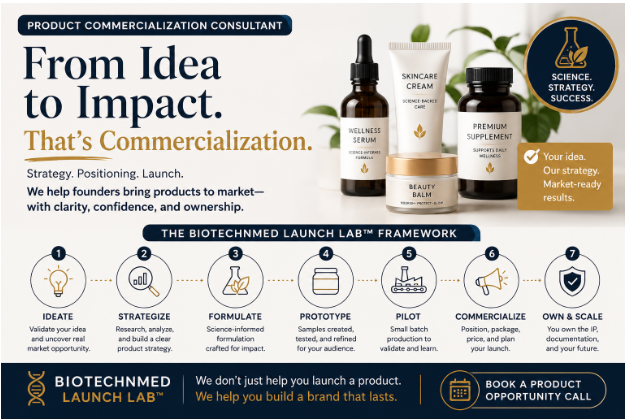
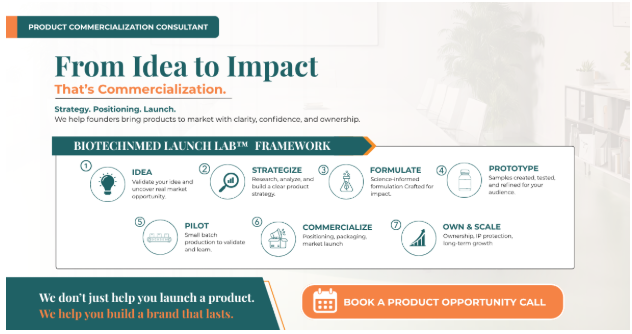
The Launch Lab Framework
At BiotechNmed Launch Lab, the process is built around one structured pathway from idea to asset.
Step 1: Market Ideation
Define the concept, target customer, market opportunity, and product positioning.
Step 2: Feasibility & Strategy
Evaluate the product category, formula direction, commercial viability, timeline, economics, and manufacturing pathway.
Step 3: Scientific Formulation
Develop a proprietary, science-informed formula direction aligned with the product vision and market goals.
Step 4: Prototype & Testing
Create samples, gather feedback, and refine the product before pilot production.
Step 5: Pilot Production
Prepare a small pilot batch to validate product experience, customer feedback, and launch readiness.
Step 6: Commercialization Planning
Build the pricing, positioning, packaging direction, claims guardrails, sales channel strategy, and launch roadmap.
Step 7: Scale-Up & Ownership Transfer
Receive the documentation, SOPs, formula direction, and manufacturing pathway needed to continue building independently.
Internal link: Explore the Launch Lab Framework
Common Product Commercialization Mistakes Founders Should Avoid
Founders should avoid:
Treating commercialization as the final step
Talking to manufacturers before strategy
Choosing private label only because it is faster
Building packaging before positioning
Launching without market validation
Ignoring pricing strategy
Ignoring claims guardrails
Skipping pilot feedback
Scaling before testing demand
Not asking who owns the formula and documentation
Hiring a launch agency before the product strategy is clear
Treating the product like inventory instead of an asset
BiotechNmed Launch Lab helps founders avoid these mistakes by building the pathway before the product is scaled.
Final Answer: What Is a Product Commercialization Consultant?
A product commercialization consultant helps founders bring product ideas to market through market validation, positioning, pricing, go-to-market strategy, pilot planning, launch readiness, and scale-up support.
But if you are building a skincare, supplement, beauty, wellness, longevity, or health-focused product, you need more than a generic launch consultant.
You need a strategic pathway that connects:
The idea
The market
The product category
The formula direction
The prototype
The pilot batch
The claims guardrails
The pricing strategy
The packaging direction
The launch roadmap
The documentation
The ownership pathway
That is what BiotechNmed Launch Lab was built to do.
Your product idea does not need more scattered advice.
It needs a commercialization pathway.
BiotechNmed Launch Lab is that pathway.
Ready to Bring Your Product Idea to Market?
You do not need to keep guessing.
You do not need to spend months researching manufacturers.
You do not need to settle for a generic private-label product if your goal is ownership.
BiotechNmed Launch Lab helps founders turn product ideas into science-informed, market-ready product pathways through strategy, formulation direction, prototype planning, pilot production, commercialization, and ownership support.
If you have an idea for a skincare, supplement, wellness, beauty, longevity, or health-focused product, start with clarity.
Book a Product Opportunity Call with BiotechNmed Launch Lab and find out what it would take to bring your product idea to market.
CTA: Book a Product Opportunity Call
FAQ
What is a product commercialization consultant?
A product commercialization consultant helps founders bring product ideas to market by supporting market validation, product positioning, pricing strategy, go-to-market planning, launch readiness, pilot feedback, and scale-up planning.
What does a product commercialization consultant do?
A product commercialization consultant helps connect the product to the market.
This may include customer research, competitive analysis, product positioning, pricing, claims guardrails, sales channel strategy, launch planning, pilot launch strategy, and commercialization roadmap development.
What is the difference between product development and product commercialization?
Product development focuses on creating the product.
Product commercialization focuses on bringing the product to market.
For skincare, supplement, wellness, beauty, and longevity products, both should be connected from the beginning.
When should I hire a product commercialization consultant?
You should consider hiring a product commercialization consultant before investing heavily in manufacturing, packaging, launch campaigns, or inventory.
Early commercialization strategy helps clarify the market, positioning, pricing, claims, and launch pathway before costly decisions are made.
How much does product commercialization consulting cost?
The cost depends on the product category, stage of development, complexity, research needs, launch support, and level of execution.
A full product development and commercialization pathway usually requires deeper support than a one-time strategy session.
What is a typical product commercialization timeline?
The timeline depends on the product category, complexity, prototype status, testing needs, packaging, manufacturing pathway, and founder readiness.
BiotechNmed Launch Lab is built around a structured 90–120 day pathway for many product concepts, depending on readiness and complexity.
How do I choose a product commercialization consultant?
Choose a consultant or partner who understands your product category, market validation, product positioning, claims guardrails, go-to-market strategy, manufacturer readiness, pricing, launch planning, and ownership-focused documentation.
Do skincare founders need a product commercialization consultant?
Skincare founders can benefit from commercialization support because skincare products require product positioning, claims guardrails, packaging strategy, customer education, market differentiation, and launch planning.
Do supplement founders need a product commercialization consultant?
Supplement founders can benefit from commercialization support because supplement products require ingredient positioning, category-aware claims, customer education, pricing strategy, launch planning, manufacturer readiness, and commercialization structure.
How can BiotechNmed Launch Lab help me commercialize my product?
BiotechNmed Launch Lab helps founders move from product idea to science-informed, market-ready product pathway through market ideation, feasibility strategy, formulation direction, prototype development, pilot production planning, commercialization roadmap, claims guardrails, and ownership-focused documentation.
SEO FAQ Schema
<script type="application/ld+json">
{
"@context": "https://schema.org",
"@type": "FAQPage",
"mainEntity": [
{
"@type": "Question",
"name": "What is a product commercialization consultant?",
"acceptedAnswer": {
"@type": "Answer",
"text": "A product commercialization consultant helps founders bring product ideas to market by supporting market validation, product positioning, pricing strategy, go-to-market planning, launch readiness, pilot feedback, and scale-up planning."
}
},
{
"@type": "Question",
"name": "What does a product commercialization consultant do?",
"acceptedAnswer": {
"@type": "Answer",
"text": "A product commercialization consultant helps connect the product to the market. This may include customer research, competitive analysis, product positioning, pricing, claims guardrails, sales channel strategy, launch planning, pilot launch strategy, and commercialization roadmap development."
}
},
{
"@type": "Question",
"name": "What is the difference between product development and product commercialization?",
"acceptedAnswer": {
"@type": "Answer",
"text": "Product development focuses on creating the product. Product commercialization focuses on bringing the product to market. For skincare, supplement, wellness, beauty, and longevity products, both should be connected from the beginning."
}
},
{
"@type": "Question",
"name": "When should I hire a product commercialization consultant?",
"acceptedAnswer": {
"@type": "Answer",
"text": "You should consider hiring a product commercialization consultant before investing heavily in manufacturing, packaging, launch campaigns, or inventory. Early commercialization strategy helps clarify the market, positioning, pricing, claims, and launch pathway before costly decisions are made."
}
},
{
"@type": "Question",
"name": "How much does product commercialization consulting cost?",
"acceptedAnswer": {
"@type": "Answer",
"text": "The cost depends on the product category, stage of development, complexity, research needs, launch support, and level of execution. A full product development and commercialization pathway usually requires deeper support than a one-time strategy session."
}
},
{
"@type": "Question",
"name": "How can BiotechNmed Launch Lab help me commercialize my product?",
"acceptedAnswer": {
"@type": "Answer",
"text": "BiotechNmed Launch Lab helps founders move from product idea to science-informed, market-ready product pathway through market ideation, feasibility strategy, formulation direction, prototype development, pilot production planning, commercialization roadmap, claims guardrails, and ownership-focused documentation."
}
}
]
}
</script>
Article Schema
<script type="application/ld+json">
{
"@context": "https://schema.org",
"@type": "BlogPosting",
"headline": "Product Commercialization Consultant: How Founders Bring Product Ideas to Market",
"description": "Learn what a product commercialization consultant does, when to hire one, and how BiotechNmed Launch Lab helps skincare, supplement, wellness, beauty, and longevity founders bring product ideas to market with strategy and ownership.",
"author": {
"@type": "Organization",
"name": "BiotechNmed Launch Lab"
},
"publisher": {
"@type": "Organization",
"name": "BiotechNmed Launch Lab",
"url": "https://www.thebiotechnmed.com"
},
"mainEntityOfPage": {
"@type": "WebPage",
"@id": "https://www.thebiotechnmed.com/product-commercialization-consultant"
}
}
</script>
Compliance Note
BiotechNmed Launch Lab provides product development and commercialization strategy. This article is for educational and business planning purposes only and should not be interpreted as legal, regulatory, medical, or financial advice. Product claims, labels, advertising, and commercialization materials should be reviewed by qualified legal or regulatory professionals before launch.
Sources
FDA Authority Over Cosmetics: How Cosmetics Are Not FDA-Approved, but Are FDA-Regulated
FDA Modernization of Cosmetics Regulation Act of 2022 — MoCRA
FDA Questions and Answers on Dietary Supplements
FTC Health Products Compliance Guidance
U.S. Small Business Administration: 10 Steps to Start Your Business
USPTO Intellectual Property Resources